




Table of Contents
Today’s Chirp Transducers: A Multitude of Frequency Ranges
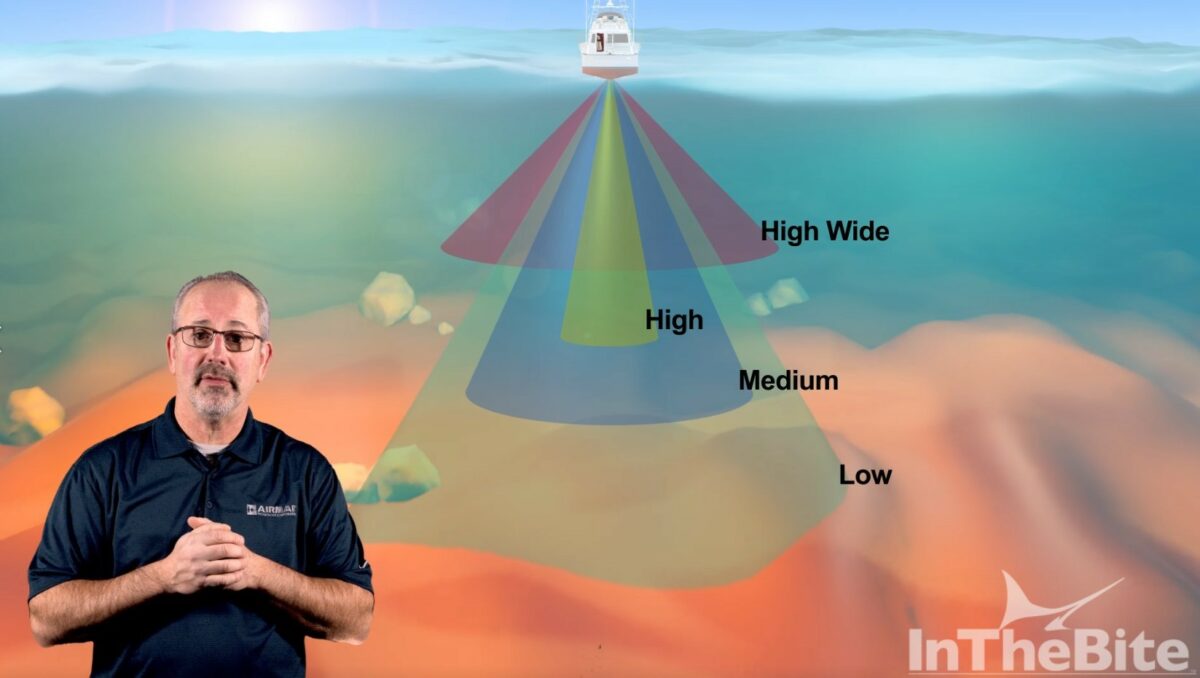
Today’s Chirp transducers are available in a multitude of frequency ranges that a captain can choose from. The frequency chosen is often the key to catching more fish, especially if the frequencies used match the style of fishing you’re doing that day. And having access to multiple frequencies on board gives the flexibility to pick and choose the right “tool for the job.” Models to choose from in the 1kW line from transducer manufacturer, Airmar, is Low, High, Medium, High Wide-beam, and Medium Ultra-Wide-beam.
The Popularity of Low and High-Wide Frequency Models
In the last ten years, Airmar’s sales of the Low and High-wide models have soared. It’s easy to see why having these two frequency bands at your fingertips is so popular. When searching out deep for species over one thousand feet, the Low frequencies (42-65kHz) are key to finding fish. In-shore, the High frequency (150-250 kHz) wide-beamed models can help locate game fish in the top 500 feet, and is the perfect search tool for schools of bait.
The Role and Advantages of Medium Frequencies
The natural questions are, where do Medium frequencies (85-135 kHz) have a place, and how can they outperform the frequency bands mentioned above? The nature of the frequencies in the medium band will travel deeper in the water column than high frequency models, making it a great choice for depths to fifteen hundred feet. But where it really shines is in the six-to-nine-hundred-foot range. At 1kW of power output, this range is the sweet spot for performance. And because the frequencies are higher than those in a Low model, the resolution is better, meaning the target detection and separation will be better on your fishfinder screen. The beamwidth on a medium frequency model is also narrower than Low which, again, helps with target resolution.
Introducing Airmar’s B175MW: Medium Ultra-Wide Beam Model
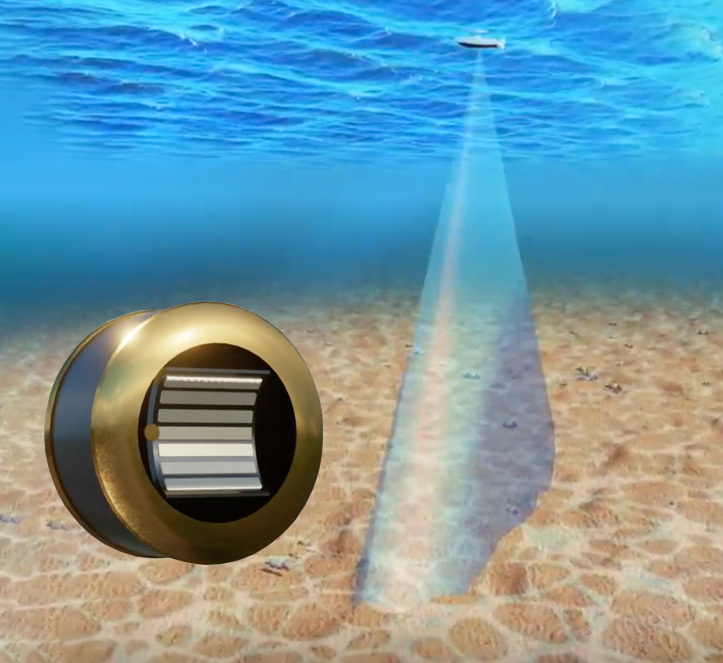
This past year, Airmar put a new spin on the Medium frequency model, and added an ultra-wide beam model, called the B175MW. Their standard Medium model, the B175M has beamwidths from 16° to 11° from lowest to highest frequency. The B175M has a nice beamwidth providing good coverage, but Airmar’s customers asked for a wider beam for more coverage. Airmar completely rethought the design on the Mediums and created a seven-element array which delivers a massive port to starboard coverage of up to 73° and a fore/aft beamwidth of 16°. This fan shaped beam, combined with the frequencies from 60-100 kHz, delivers an ultra-wide coverage area in the water column that can detect targets as deep as 1300’. Add in the higher frequencies (than Low) and you have an amazing fish finding tool on board.
Modern Electronics and the B175MW Advantage
The modern electronics found on sportfishing boats have the ability to utilize multiple frequency bands. The new Medium Ultra-wide is the perfect addition for those boats, targeting pelagic species and deep species. With a massive coverage, the B175MW is a deep searchlight and delivers the resolution to determine whether it is a school of squid or a single gamefish. Low frequency models still hold the deep-water crown for depths out to 3000’. And High frequencies deliver amazing target separation in shallow waters. But nothing is better than the combination of frequency and coverage like the newest creation from Airmar, the leader in Chirp transducer technology.