


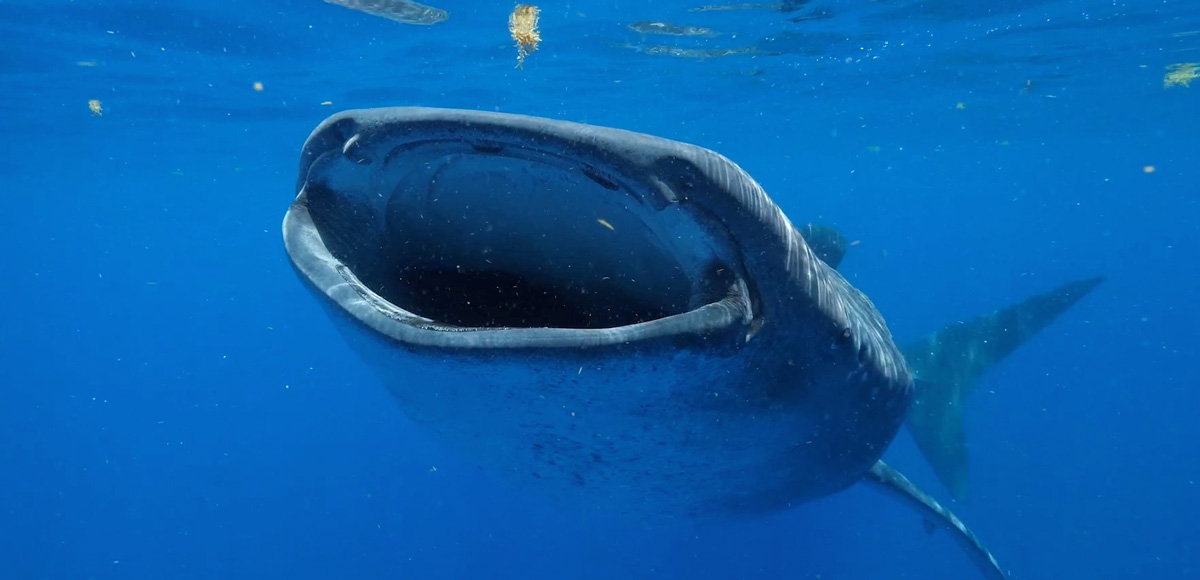

Fort Lauderdale, Fla. (September 11, 2026) – The Guy Harvey Foundation (GHF), a not-for-profit entity dedicated to protecting marine life and introducing the next generation to the ocean through education and scientific research, in partnership with Mexican conservation organization Ch’ooj Ajauil AC (NSU) and the University of Rhode Island (URI), recently satellite tagged a 26-foot-long male whale shark, nicknamed ‘Milo,’ for the fifth time over ten years. This sequential tagging effort has provided the longest record of a shark’s movements, offering groundbreaking insight into the life history of these long-lived marine creatures.
A Decade of Data: Milo’s 34,000-Mile Journey
Over the course of almost a decade (3,400+ days), Milo has returned regularly to an annual whale shark aggregation located just offshore of the Yucatan Peninsula in the Caribbean Sea. This seasonal aggregation has allowed researchers recurring access to individual whale sharks, which can be identified by unique spot patterns and dorsal fin shape. Milo’s tag only reported data for a couple of weeks after he was originally tagged in 2017, as researchers were still perfecting the tagging method. Since then, researchers successfully deployed fin-mounted satellite tags on Milo four additional times, in 2018, 2020, 2023 and most recently in July 2026, resulting in unprecedented, long-term data reporting.
To date, researchers have tracked Milo for more than a record-breaking 34,000 miles, where he has traveled extensively throughout the Gulf, around the northern Caribbean islands, east of Bermuda and as far north as Massachusetts.
“Long-term studies like these are critical to better understanding the complete life history of these long-lived animals,” says world-renowned artist, scientist, conservationist and GHF Founder/Chairman Emeritus Dr. Guy Harvey. “Being able to retag an individual animal five times and follow it for almost a decade is unprecedented and will provide tremendous information to better understand and conserve this endangered species.”
Understanding Whale Shark Migration Patterns
Whale sharks (Rhincodon typus) are the largest fish in the sea, growing up to 61.7 feet on average — three times the length of a Great White Shark and approximately 17 feet longer than a school bus. Known for being nomadic, whale sharks mostly travel solo, though scientists have learned there are times when they gather in large numbers in feeding aggregations.
“Milo is a highly significant whale shark, a large sub-adult male measuring more than eight meters in length,” said Rafael de la Parra from Ch’ooj Ajauil AC. “He was the first one I fitted with a real-time, fin-mounted satellite transmitter. Over the course of nearly 10 years, I have had the opportunity to replace his transmitters several times, and last month I was able to attach the fifth device.”


The Yucatan Peninsula Whale Shark Aggregation
Every summer, whale sharks and manta rays from all over the Gulf and northwestern Atlantic Ocean aggregate in the waters offshore of the Yucatan Peninsula to feed on fish eggs and larvae that float on the water’s surface during this time of year. After a noticeable decline in the number of animals at the site in recent years, the 2026 aggregation has hosted an abundance of whale sharks and manta rays, with hundreds of animals present daily. This aggregation has become a highly successful ecotourism destination, where local boat captains bring tourists out on the water to swim with the largest fish in the ocean.
“Milo has revealed just how flexible whale sharks can be, demonstrating the capability of enormously far-flung migrations way out into the Atlantic, yet equally content with ‘staying put’ for months at a time in small regions,” says Dr. Mahmood Shivji, Director of the Guy Harvey Research Institute at Nova Southeastern University. “These sharks are clearly equally at home in the far offshore deep ocean as they are in shallow coastal areas, despite how different those environments are!”
Why Whale Shark Conservation Research Matters
Since 2017, the research team has deployed 48 fin-mounted satellite tags on whale sharks in the region to better understand the migration patterns of this species. Whale sharks are classified as “Endangered” by the International Union for Conservation of Nature due to overfishing and ship strikes. Previous research conducted by the Guy Harvey Research Institute (GHRI) at Nova Southeastern University showed that whale sharks can live upwards of 125 years. Long-term research programs like this — and the data provided by satellite tags on retagged sharks like Milo — are fundamental to helping conserve the species.
As part of their ongoing research into the marine ecosystem, NSU’s Guy Harvey Research Institute (GHRI) researchers study the migratory patterns, genomes and other aspects of various shark species, including whale sharks, tigers, makos and oceanic whitetips, as well as marlin and sailfish. The data they collect is used to protect these animals for generations to come. Milo’s track, and the tracks of all other species tagged by GHRI, can be viewed online at www.GHRItracking.org.
About the Guy Harvey Foundation
With a focused mission to better understand and conserve the ocean environment, the Guy Harvey Foundation (GHF) collaborates with local, national and international organizations to conduct scientific research and provides funding to affiliated researchers who share this objective. GHF’s educational efforts include professional development opportunities for educators and the creation of resources for students and marine enthusiasts to better understand the importance of our oceans and their inhabitants. For more information, visit www.GuyHarveyFoundation.org. Follow GHF on Facebook at www.facebook.com/GuyHarveyOcean, on LinkedIn at www.linkedin.com/company/guyharveyfoundation, or on Instagram at www.instagram.com/GuyHarveyOcean.
About Nova Southeastern University
Nova Southeastern University (NSU) is the largest private research university in Florida and a top employer in the state, with more than $6.7 billion in projected economic impact. NSU is classified as an R1 institution by the Carnegie Foundation among universities with the highest level of research activity. Visit www.nova.edu.
About Ch’ooj Ajauil AC
Ch’ooj Ajauil AC is a non-profit organization working to ensure a healthy, sustainable, and biologically diverse future for the coastal region in North Quintana Roo, Mexico, and now expanding to both coasts of Mexico. Ch’ooj Ajauil AC also analyzes the effects of whale shark tourism, which can be used to improve conservation schemes for the species by working directly with environmental authorities, local guides, and tour boat operators.