





Table of Contents
Advancements in Technology Have Changed Tournaments Forever
Technology in sportfishing tournaments has revolutionized the way events are conducted and competed in. On the third and final day of the 2022 Pirate’s Cove Sailfish Classic, held in Port Salerno, Florida, the 80-foot Viking, Frigate, part of the Carl Allen fleet of Walker’s Cay fame, went fishless the first day. But they ended day two second in the boat standings with two releases, and the team, with Capt. Ian Weber at the helm, was eyeing a win. “We were sitting out there with the pack thinking the conditions were okay, but everyone was kind of picking away, so we had to move,” said Weber. “That’s when we did what we call our ‘power move’.”
Technologically, that meant Frigate used its Roffer’s Ocean Fishing Forecasting Service report (ROFFS), which takes variables such as water temperatures, currents, water color, and more, into account and then electronically delivers a detailed map and text description to pinpoint where the fish are. “We ended up going three for four in the last hour, and we caught two of a triple header in the last half hour,” Weber said. “We missed the other one, but if we had an Omni sonar, we could have followed him right till the last buzzer of the day to try and catch him.” In the end, Frigate won the third day daily, tied first on releases, and finished third in the boat standings on time.
It’s amazing how much technology has changed in sportfishing tournaments, on both the participant and organizer sides. One of the biggest changes tournaments have seen over the last two decades, especially those along the northern Gulf Coast is in the boats themselves. “Two main themes have happened almost simultaneously,” said Bert Merritt, tournament coordinator for the Mississippi Gulf Coast Billfish Classic (MGCBC), held in Biloxi, Mississippi. “One is that sport-fishers are larger and faster with tremendous range, while secondly, center console boats have grown in number, speed, and size. From less than five percent of entries, center consoles often time now make up 15 to 20 percent of a tournament fleet.”
Technological Advancements in Boats
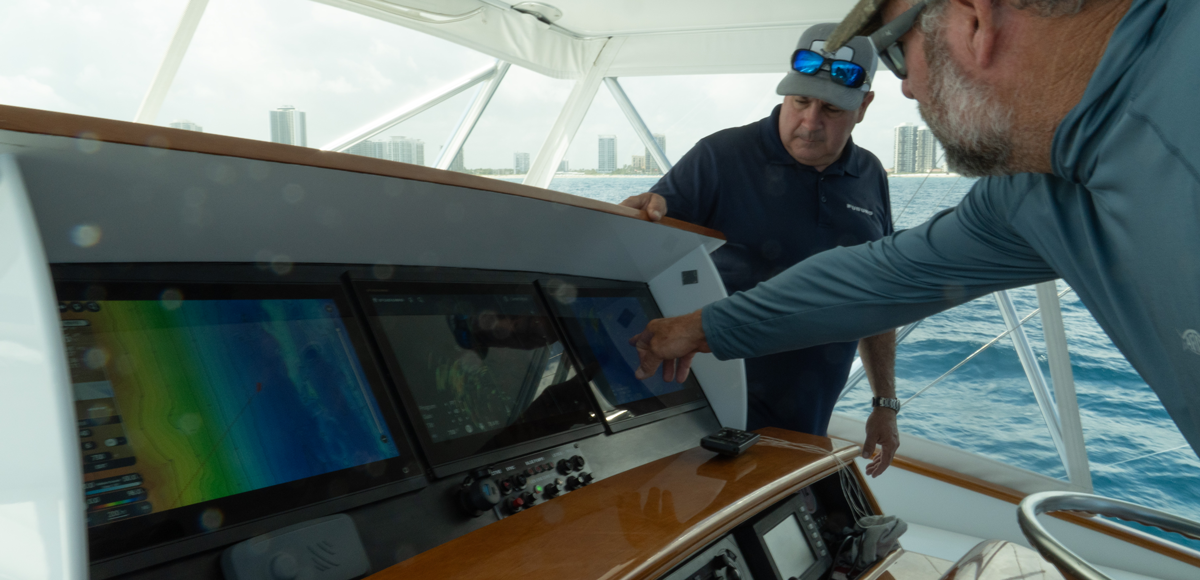
Technology on both types of boats has advanced. Nowhere is that more prevalent than in fish-finding, and especially during tournaments, communicating, confirming, and scoring that catch. “‘Flashers’ were early machines used to determine water depth, which then evolved to fathometers, which were paper recorders,” adds Jim Motsko, who with daughters Madelyne and Sasha Motsko directs the White Marlin Open, in Ocean City, Maryland. “Then came video sounders and eventually, ‘Chirp’ technology. Now we have Omni Sonar, which is almost commonplace due to it becoming smaller and less expensive. This has also led to an additional crew member to monitor the sonar.”

OMNI Sonar: A Game-Changer
The use of sonar in tournaments has led to heated debate, with the have-nots claiming an unfair advantage. Therefore, some tournaments have created sonar and non-sonar divisions.
“In the northern Gulf, tournaments for the most part allow sonar use,” says the MGCBC’s Merritt. “Several tournaments have incorporated a non-sonar category that teams without sonar can opt into. So far, the teams opting into these non-sonar categories have been few in comparison to the majority of categories, but it does allow them an option to compete against other teams without the technology,”.
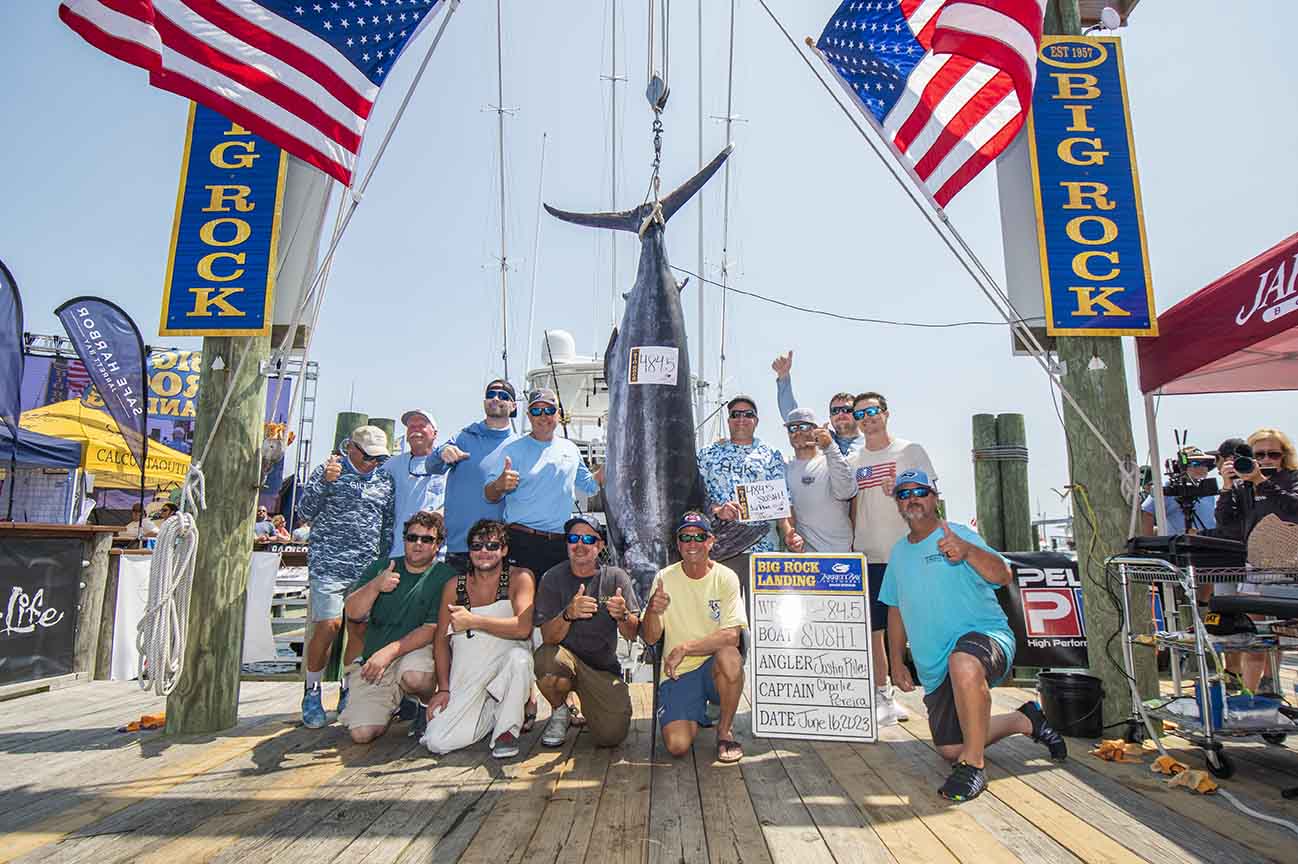
On the east coast, since the Big Rock Blue Marlin Tournament is a big-fish tournament, organizers decided not to split all the levels between sonar and non-sonar boats. Instead, “A decision was made to split the release category, which is a big cash prize, between sonar and non-sonar boats,” says Madison Struyk, executive director, of the Morehead City, North Carolina-based event.
Directors of the Walker’s Cay Blue Marlin Invitational, in the Bahamas, decided against instituting sonar and non-sonar divisions. “We did a poll of the boats that fished our tournament the second year, and 80 percent of them had sonar and 20 percent didn’t,” says Ryan Edwards, director of the 50-plus-boat tournament. “By the third year, boats with sonar were pushing 85 percent.” Similarly, coordinators of the White Marlin Open, which drew 400 boats last year, opted not to have separate Omni and non-Omni categories. Why? “We foresee Omni Sonar becoming standard on boats in the future,” said Madelyne Motsko.
On the organizer’s front, adding tournament rules based on ever-evolving technology can become a slippery slope, said Aaron Hoffman, director of the Cape May, New Jersey-based MidAtlantic tournament, which paid out over $5.7 million in prizes last year. “Level playing field has always been a term that’s used when you talk about Omni sonars, but let’s be realistic with these bigger tournaments,” Hoffman said. “There really is no level playing field. Somebody’s going to have a faster boat. Somebody’s going to have a smaller boat. Somebody’s going to have all the bells and whistles. Somebody’s going to have a crew of family and somebody’s going to have a crew of professional mates.
“Is there going to be a rule that boats that can only go 15 knots get an hour head start on those that go 30?” Hoffman added. “How many rules are you going to develop to take the fun out of the game? After all, how many sports are there where a couple of teenagers can throw together some money, fish against billionaires, and win? It’s fishing.”
Ship-to-Shore Communications
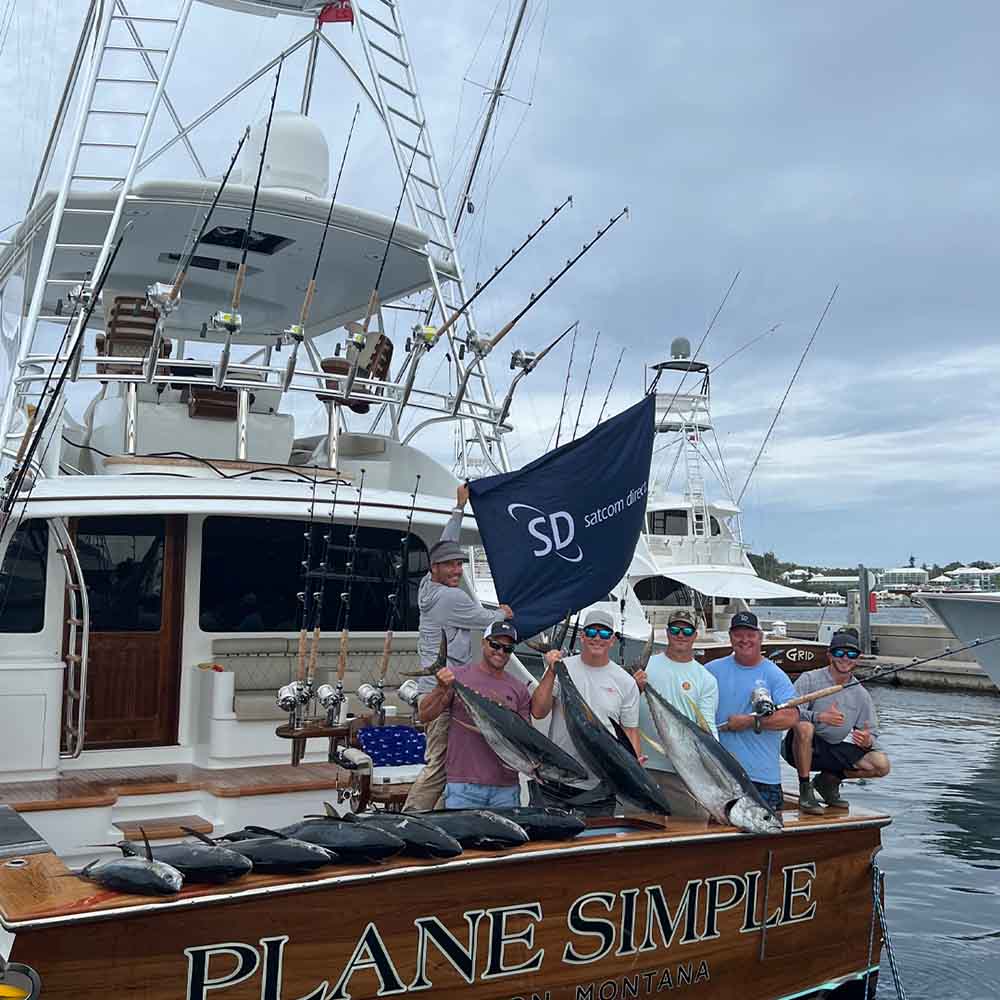
In the early days, “Most boats used VHF and single-sideband radios to transmit messages,” says the White Marlin Open’s Jim Motsko. “Then came satellite telephones. Now, inReach and Starlink have made connectivity offshore possible.” Onboard communications technology proved useful to Capt. Chris Weeks, on the 77-foot Spencer, Plane Simple, owned by Jim Jensen, in last year’s Bermuda Big Game Classic. Thirty minutes before lines out on the tournament’s last day, the team raised and hooked a large fish that they had full intentions of bringing in to weigh. “We fought the fish for 4 1/2 hours into the dark and ultimately broke the hook at 9: 30 p.m.,” said Weeks, whose team finished second in the 2023 Bermuda Triple Crown Billfish Championship out of 42 boats. “Through our onboard satcom capabilities, we were able to communicate our intentions and status long after anyone in tournament control was monitoring the VHF tournament channel.” Plane Simple doubles as Satcom Direct’s maritime demonstration platform.
Many boats have Garmin inReach, says Walker’s Cay Invitational’s Edwards. “They’ll text me with messages like ‘Hey, I hooked up on a blue at 10:00 a.m.,’” he said. “Starlink units are on most of the hardcore sport-fishing boats now. Starlink’s been a game-changer. Say, for example, someone releases a 500-pound blue marlin and they have footage of it. We can request it in real time just for entertainment purposes. If they have Starlink, they can send it to us. Then we can post it on social media as an update and it’s out to the world in under an hour.”
Starlink indeed offers a significant opportunity for tournament exposure. “Being able to communicate with participants offshore in real-time during fishing hours provides a unique ‘behind the scenes’ look,” said The Big Rock’s Struyk. “This brings the offshore action, a crucial part of the tournament experience, into the spotlight. This capability creates space for sponsorships, interviews, exclusive content, and participant-to-public interaction.”
Catch-and-Release Verification
There was a time when a dead fish on the dock or hanging on the scales was all the catch verification needed. No longer. “Twenty-six years ago, we changed the Key West Marlin Tournament to an all-release tournament,” says Tim Greene, chairman. “When we did that, we had to invoke some type of technology, so people were confident that what was released was released. We started handing out disposable cameras. One of the rules was you had to take a picture with the mate holding the leader with the fish. Then GoPro’s came out. We still use GoPro’s. The boats turn in the chip at the end of the fishing day, and we process it on our computers.”
To ensure an official release wasn’t a figment of someone’s technology with the timestamp changed, Greene and his team devised a color-coded validation card system. Each morning, they radio the card color of the day, and then an angler or mate on each boat takes a video holding that card. Organizers then know whatever release video follows next comes from that day. In the last few years, the tournament has allowed the use of video on a cell or iPhone because it can be validated.
As video equipment has become more advanced and easier to use, reviewing video has taken a stronghold for determining the winners in Gulf Coast tournaments, says the MGCBC’s Merritt. “The obvious advantage of video review is there is a huge savings in observer expenses for a 100-plus boat tournament,” he said. “It also provides permanent video documentation as well as exciting video footage for use in the promotion of the tournament. This method does come with its issues, the biggest of which is the lack of similar equipment and video expertise from team-to-team. Most teams targeting the release awards utilize individuals whose sole job on the team is to ensure quality video is taken and presented to judges for verification of their releases. Unfortunately, this means some catches for unskilled teams are not awarded release points due to poor-quality video. It is remarkable, in my opinion, the increase in video quality from year to year as teams are increasingly getting better at it.”
Scoring Programs
In Biloxi, when the MGCGC first started in 1997, organizers wanted to provide as close to real-time scoring as possible. This was so that when they finished the weigh-in, they could calculate tournament payouts quickly and accurately, “It took us 10 years to bring that concept to reality,” said Merritt. “We became much like the PGA golf tournaments in live scoring, in that as each putt was sank or in our case, fish was weighed, all cash awards were re-calculated and displayed online within seconds. We evolved and ran our home-grown system for another 10 years but ultimately moved to CatchStat, a modern, cloud-based scoring system we use now. The functionality is exactly what we need to get information quickly and accurately into the database and out to the participants, apps, and online community viewing it.”
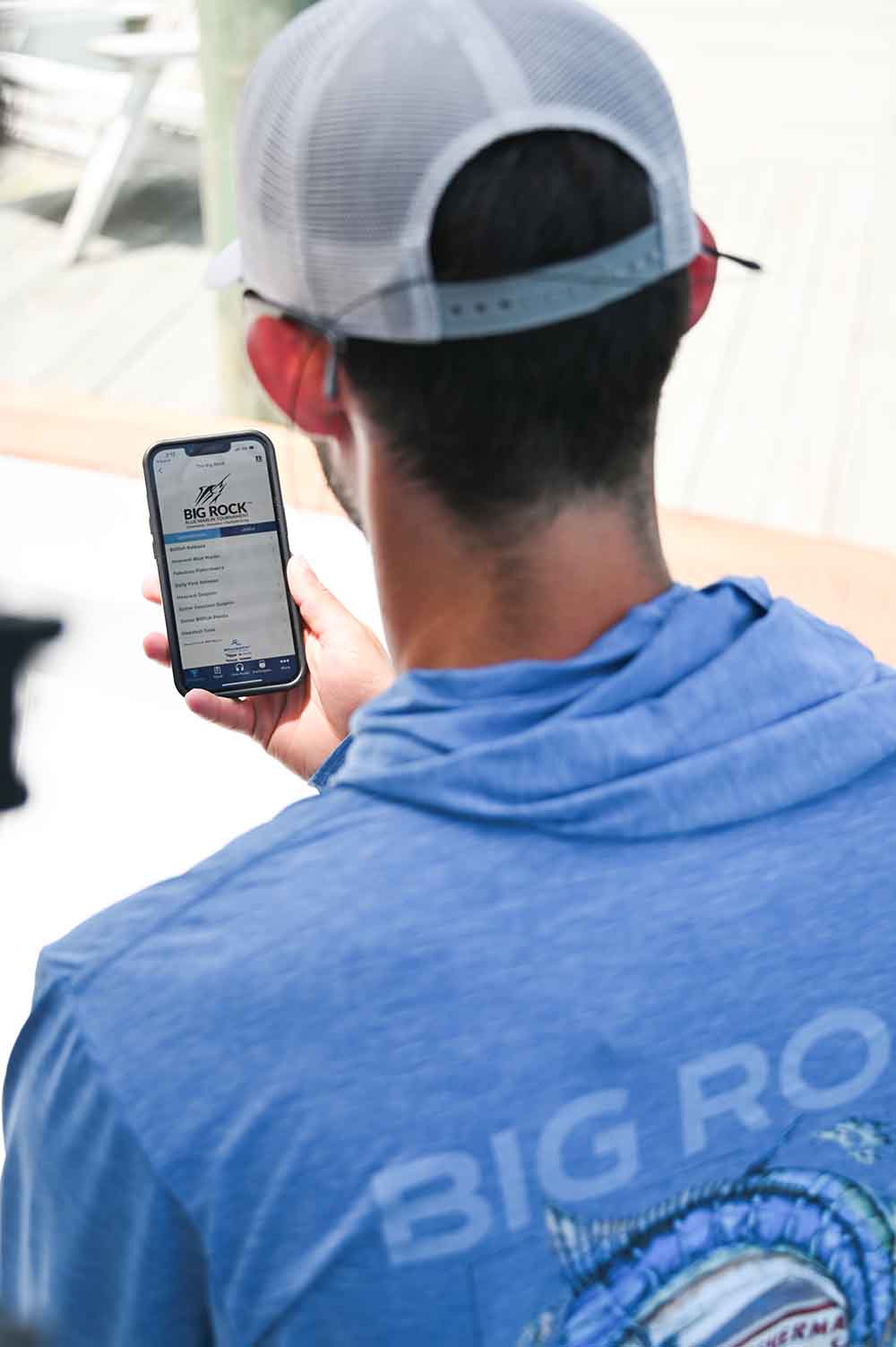
The go-to tool for tournament operations in The Big Rock is The Big Rock app, powered by Reel Time Apps. It manages live scoring, prize money calculations, and online registration, and keeps the leaderboard updated in real-time. “Scoring software has significantly reduced user errors in data entry, automatically exporting tournament spreadsheets when necessary,” said Struyk. “This eliminates the need to hire a statistician. The real-time scoring updates it provides are a major win for tournament officials, relieving the staff from doing manual calculations for participants and the public.” Live scoring benefits sportfishing teams too.
“This is especially true in tournaments like Walker’s or some of Skip’s (Smith) tournaments, where the boats are spread out and you don’t hear everybody on the radio,” said Weber. “It’s good to be able to keep your eye on the scoreboard and who’s doing what.” Of technological advancements and tournament fishing, Weber adds, “I’m all for it. Technology moves the world forward. You either get on board or you get left behind.”


Dive Deeper into the World of Sportfishing
You’ve just experienced a taste of the exceptional content featured in the pages of InTheBite Sportfishing Magazine. If you found this engaging, you’re in for a treat with our full publication. Whether you prefer the tactile experience of print or the convenience of digital, we have the publication for you.
Visit our subscription page now to join the InTheBite family and elevate your sportfishing experience with every issue.