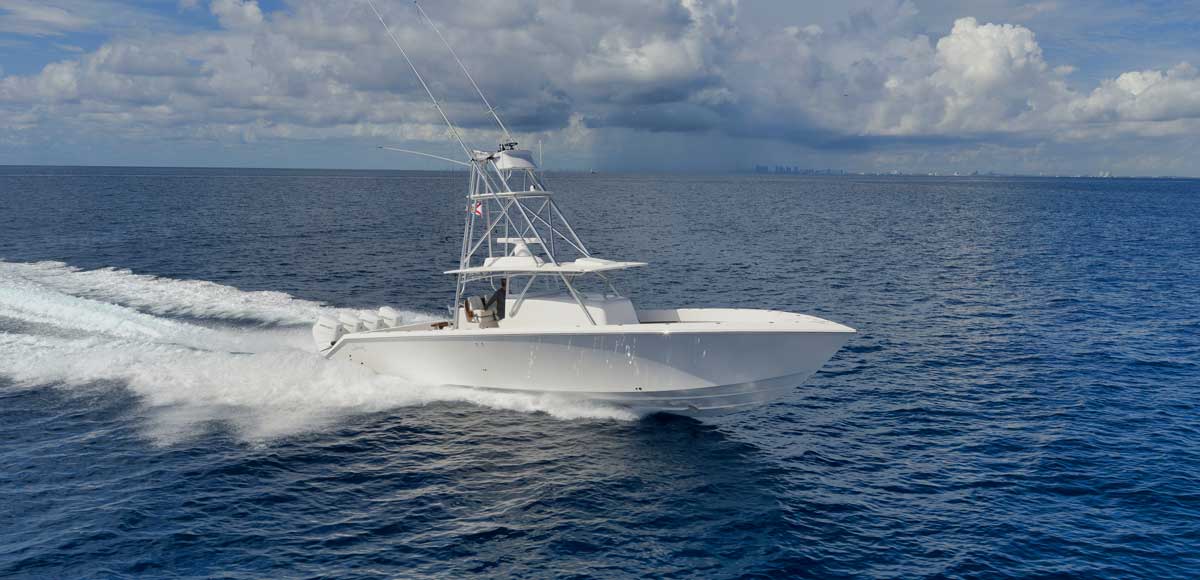



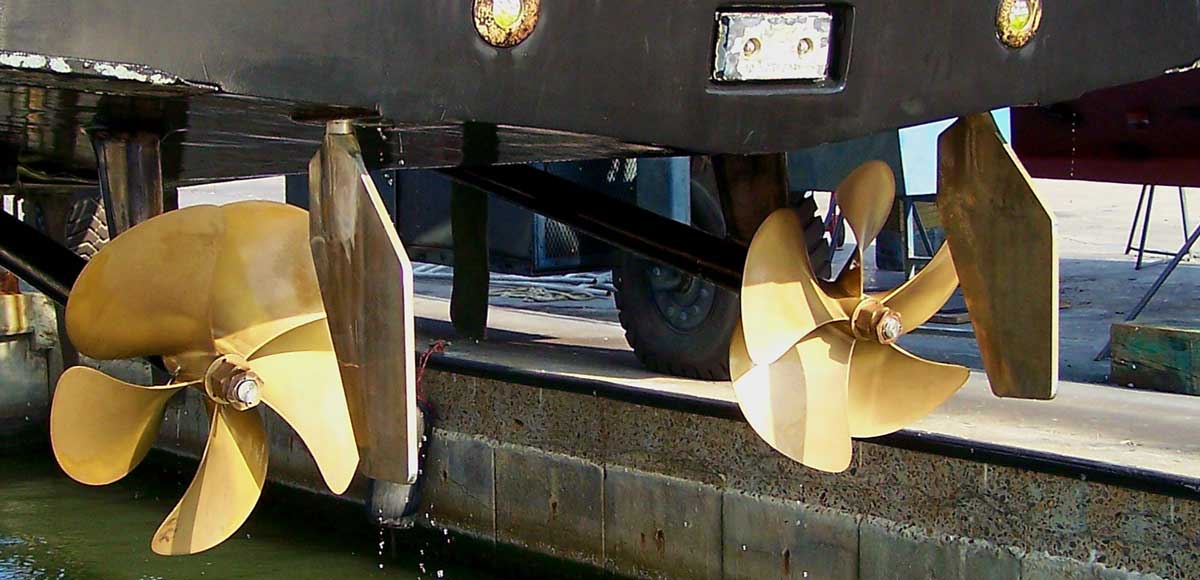

Most of our medium to large sized sportfishing machines employ submerged propellers on inclined shafts, with or without prop tunnels. We have previously discussed appendages and appropriate location of the running gear including strut, propeller, and rudder. Rudders are obviously critical to the proper handling of our high-performance hulls. Here, we’ll look at some options with specific rudder selections and some new technology which is now available.
Why Proper Rudder Sizing Matters
Appropriately sizing a rudder is vital. If it’s too small, the rudder can’t develop enough lift to overcome the forces making the hull track straight. Too large and we can observe overly aggressive turning as well as excessive drag, hurting performance. Designers use multiple equations to size rudder area. I typically use an equation which considers vessel displacement and speed. This tends to work for both displacement hulls and planing hulls. I’ll usually consider full load weight and a vessel speed somewhere between a fast cruise and WOT speed to size the rudders.
Rudder profile can be different as well, but they typically do not vary too much across our sportfishing hulls. Section shape does vary greatly and is an important decision in the choice of rudder. Sections discussed here include flat plate, wedge, parabolic, and air foil. These different sections exhibit varying operational parameters including lift and drag coefficients, resulting in different side force and rudder turning moment.
This discussion assumes that the rudder is seeing relatively clean flow, though it is seeing disturbed flow from the high-pressure side of the propeller as well as no downstream flow interference from, say, a keelson or skeg. Rudders can be manufactured with different approaches which include fabricated weldments, fully machined, cast, or even composite shapes pulled from a mold.
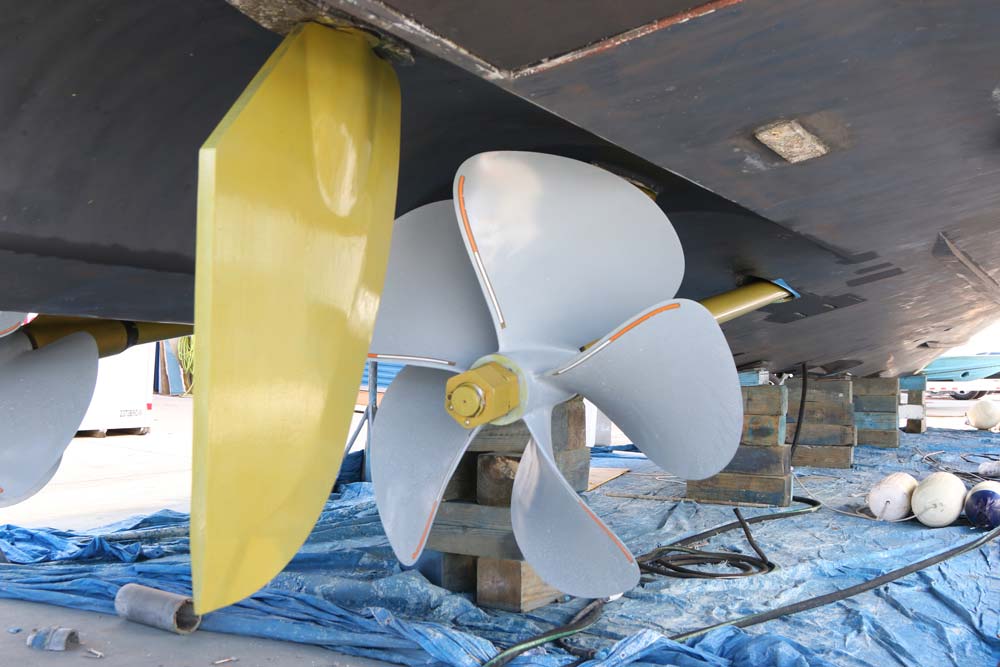
Flat Plate Rudders
Flat plate rudders are probably the most common type seen on sportfishing boats. In terms of pure performance, they are not quite the match for other section shapes. Flat plate rudders will typically have lower lift coefficients for a given speed as compared with other options with somewhat equivalent drag coefficients. However, because of their simple shape, they are more easily fabricated, and much more easily modified if necessary. Let’s consider flat plate section rudders our baseline for this discussion.
Wedge Rudders
Wedge section rudders exhibit higher lift coefficient values than flat plate with similar drag numbers. This allows for slightly less area requirements for proper turning, reducing overall rudder drag. Wedge rudders are popular as well, for while not being as simple as flat plates, the shape is relatively simple and can be adjusted if necessary.
Parabolic Rudders
Parabolic rudders also generate more lift than flat plate, with similar lift coefficients to wedge rudders. Parabolic sections can also exhibit slightly less drag than wedge rudders, but not in significant amounts. The parabolic shape is somewhat more complicated, so if modifications are required, it can require a little more effort. Parabolic rudders are not commonly used for this reason.
Air Foil Rudders
Air foil section rudders are not typically used in most recreational vessels. They don’t develop as much lift as a wedge or parabolic shape, but they can exhibit significantly lower drag. However, air foil rudders cavitate significantly differently than the other shapes discussed here. Locating the rudder near the transom increases potential for rudder ventilation to occur regardless of the rudder chosen. But because of the convex shape of the airfoil section, going from leading edge to trailing edge, they are much more apt to succumbing to transom ventilation. Because of this, when a loss of steering control occurs, air foil rudders may swing unexpectedly and not naturally trail resulting in a potentially dangerous situation. They can be quite unpredictable.
Balancing Rudder Loads and Steering Control
Regardless of the rudder section chosen, the balancing of loads forward and aft of the rudder stock is important. The stock should be located in a way that allows the rudder to trail in the flow naturally if steering system failure occurs. But this can be overdone, with too much area aft resulting in an overly loaded steering system: Either the rudders can’t be turned enough, or the system needs to be somewhat over-sized. A good standard is a stock arrangement in which approximately 25 percent of the rudder area is forward of the stock, plus or minus a few percent.
Wake Adjusted Appendages and CFD Technology
Recently, a new approach has been established which employs wake adjusted appendages. The appendage design is based on computational fluid dynamics (CFD) simulations of the flow allowing for optimized shapes. Strut, rudder, and propeller are designed using this technique, but the rudder sees significantly high-pressure flow aft of the propellers, so it is highly impactful. While this approach to rudder design does not significantly increase speeds, it can result in much smoother flow across the appendages resulting in less noise and vibration, and thus, a quieter ride. This design method can be significantly more expensive, so it is not always used.
Final Thoughts on Sportfishing Rudder Design
Like so much of sportfishing design, rudder selection and sizing is critical to having the boat handle optimally and predictably. Multiple options exist and no one type of rudder is appropriate for all vessels. It is the job of the designer to understand the goals of the builder and owner, and to help select the best option for that application.

About the Author: Originally from Annapolis, Maryland, Chris transitioned from aerospace to the marine industry early in his career. For more than two decades, he has built lasting relationships with world-class yacht builders while managing numerous new designs and builds, from patrol and rescue craft to production boats and custom sportfishing yachts. His work centers on high-performance hydrodynamics, advanced hull forms, and structural design, combining technical expertise with real-world offshore performance demands. Chris has been a contributor for InTheBite Magazine since 2020 and can been read in every issue with his Behind The Design article.”

Dive Deeper into the World of Sportfishing
You’ve just experienced a taste of the exceptional content featured in the pages of InTheBite Sportfishing Magazine. If you found this engaging, you’re in for a treat with our full publication. Whether you prefer the tactile experience of print or the convenience of digital, we have the publication for you.
Visit our subscription page now to join the InTheBite family and elevate your sportfishing experience with every issue.