


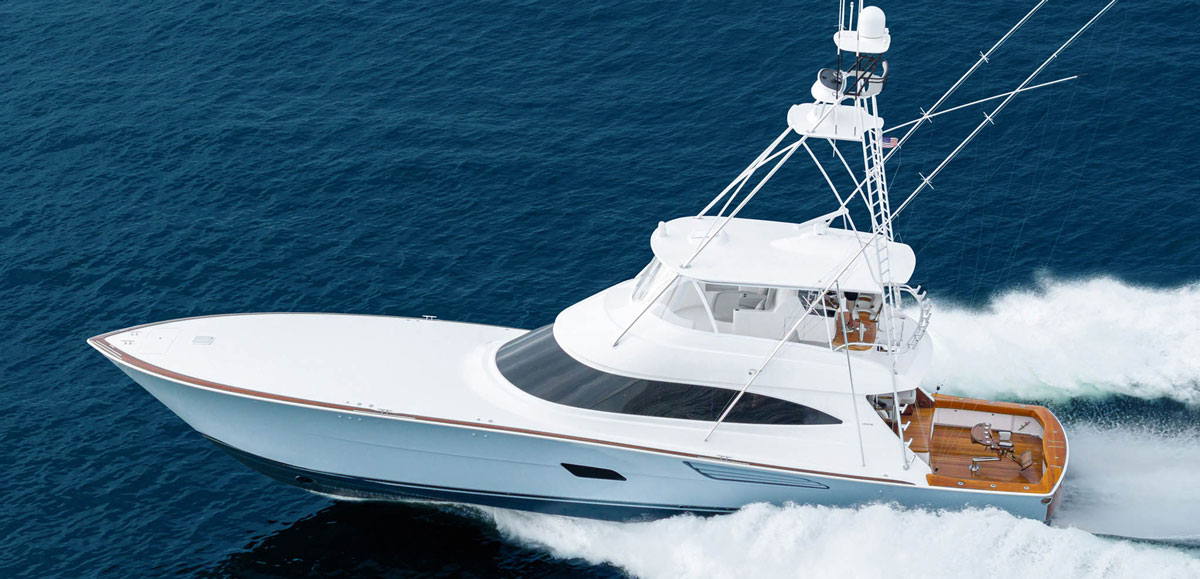

New Gretna, N.J. (May 2026) – Viking is urging boat owners, captains, marine businesses and coastal communities to submit public comments as NOAA (National Oceanic and Atmospheric Administration) reviews the 2008 North Atlantic Right Whale Vessel Speed Rule.
NOAA has issued an Advance Notice of Proposed Rulemaking and opened a public comment period on the rule, which limits operators of most vessels 65 feet and larger to 10 knots in designated seasonal areas along the East Coast. Comments are due June 2.
NOAA’s National Marine Fisheries Service created the vessel speed rule 18 years ago to help protect the endangered North Atlantic right whale from vessel strikes. In the 2008 rule itself, the agency recognized that “the use of technological solutions to minimize or eliminate a problem such as the threat of ship strikes to whales is the most desirable approach.”
NOAA is now considering whether to “modify and modernize” the rule with “alternative management areas and advanced, technology-based, strike-avoidance measures.” Viking supports NOAA’s goal of protecting the endangered North Atlantic right whale and agrees that technology-based solutions must be part of the path forward. The rule should account for today’s technology, vessel-specific risk and how modern recreational boats are built, equipped and operated.
“This review is long overdue, and now is the time for the marine industry to act,” said Viking President and CEO Pat Healey. “We need to put real-world information into the record – vessel technology, navigation tools, offshore operating conditions, vessel-size risk, safety concerns and the economic impact on coastal businesses. That is how we help make sure the rule protects whales while reflecting today’s technology, safety and access.”
Since 2022, Viking has been engaged on the vessel speed issue, working with the National Marine Manufacturers Association (NMMA), the National Marine Electronics Association and other stakeholders to raise concerns about broad speed restrictions, including safety, access, enforcement, economic impact and the lack of distinction between large ships and modern recreational boats.
Amending the 2008 rule has broader implications for the marine industry. In 2022, NOAA proposed expanding speed restrictions to boats 35 to 64 feet, a proposal the agency withdrew in January 2025. Viking believes updating the existing rule can help prevent that proposal, or similar broader restrictions, from being reintroduced.
Viking has also supported technology-based solutions through its Whale and Vessel Safety Taskforce, known as WAVS. For more than a year, WAVS has used a 24-foot Contender as a research and demonstration platform equipped with real-time detection, predictive risk mapping, information sharing and onboard alert systems designed to reduce the risk of vessel strikes while maintaining safe navigation.
The 2008 rule was adopted before many of today’s detection, awareness, and navigation technologies were available – and before those systems reached the level of precision, reliability and adoption found on modern boats. Viking believes those tools, combined with the maneuverability of recreational vessels, must be part of the regulatory solution.
The rule also carries real enforcement consequences. NOAA assessed $950,306 in civil penalties across 56 vessel-speed cases in 2022 and 2023. The rule is also being challenged in court, raising broader questions about NOAA’s authority under the current framework, including how vessel speed restrictions are enforced and how civil penalties are assessed.
“This is not about eliminating protections,” said John DePersenaire, Viking’s Director of Government Affairs and Sustainability. “It is about moving forward with NOAA’s preferred way of mitigating vessel-strike risk – technology. Conservation and safe vessel operation are not mutually exclusive, and the public comment process gives owners, captains and businesses a chance to explain why technology, vessel-specific risk, safety and economic impact must be part of any future approach.”
The easiest way to make your voice heard is through NMMA’s Boating United call to action. It includes a prewritten letter that can be submitted as-is, or you can add your own details about your boat, equipment, safety concerns and how the rule affects your ability to operate offshore. Comments also may be submitted directly through the Federal Register.
Submit Your Comments:
- Submit through Boating United: Take Action Here
- Submit directly through the Federal Register: Federal Register Link
- View the 2008 rule and map: Vessel Speed Restrictions & Map
- Official NOAA Press Release: Read the Announcement

Dive Deeper into the World of Sportfishing
You’ve just experienced a taste of the exceptional content featured in the pages of InTheBite Sportfishing Magazine. If you found this engaging, you’re in for a treat with our full publication. Whether you prefer the tactile experience of print or the convenience of digital, we have the publication for you.
Visit our subscription page now to join the InTheBite family and elevate your sportfishing experience with every issue.